

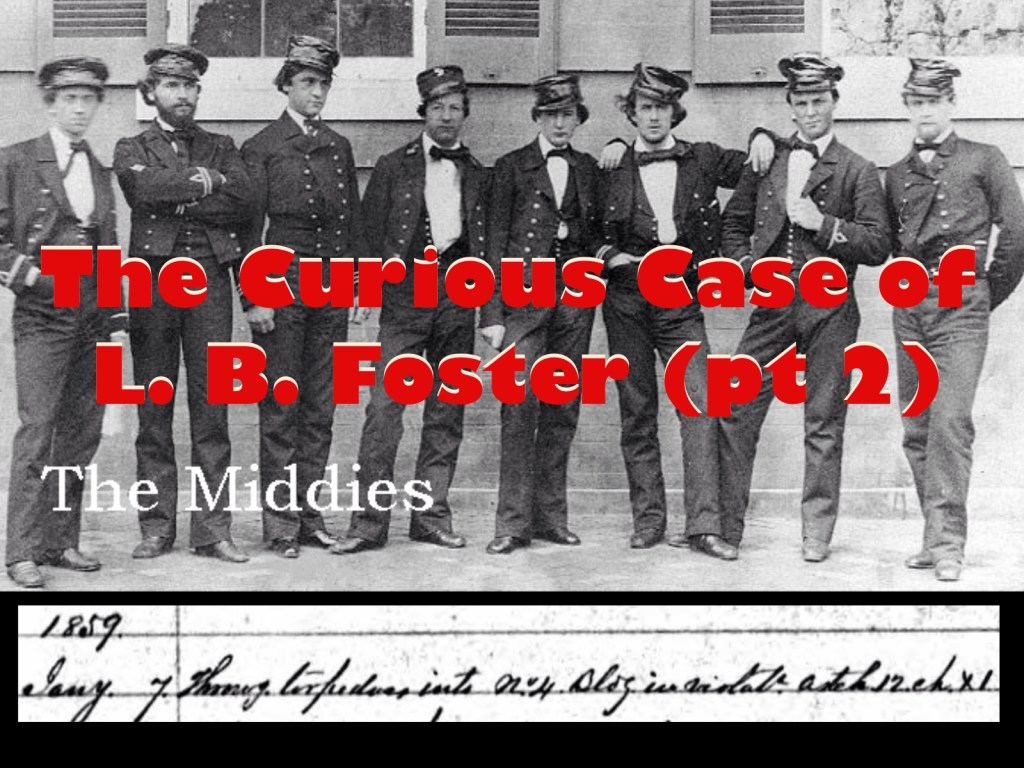
Lyman Beecher Foster was appointed to the US Naval Academy from the state of Maine by Congressman Israel Washburn jr., a founding member of the then new Republican Party. Lyman had lived since his birth in 1841 in Orono, Maine. His father Cony Foster had successful businesses there and served the community regularly, holding many town offices, which included a 25 year stint as Justice of the Peace. Both sides of Lyman’s family were New Englanders of long standing, so it is particularly odd where he ended up.
He reported to the Academy on Sept 23, 1856 and passed both the medical and academic tests. Throughout his first year, he accumulated remarkably few demerits, a total of 43 which was reduced further to 23 when the Superintendent of the Academy ordered 20 removed. (This is the year he carelessly set fire to the bedding in the hospital, noted in a former post). I have not located his academic records, but they must have been subpar for he is still listed in the fourth class for the 1857-58 school year, indicating in the parlance of the day that he had been “turned back.”
He did better repeating his plebe year, at the end ranking 27th in a class of 91 middies, and passed into the Third Class for the 1858-59 year. However, his demerits increased five fold to 112, including many tobacco infractions (smoking, chewing, and permitting others to do so).
By the end of his Third Class year he only ranked 44th out of 50, and was allowed to resign. His demerits had increased also (up to 161), of which three were violations of the regulations governing the academy. One of these states rather cryptically, “Throwing torpedoes into No 4 Bldg.” I scratched my head over that one. Originally not having found a copy of the academy regulations, all I could come up with were three possibilities:
1 – the electric ray fish
2 – the heavy, well-balanced throwing kife
3 – the explosive underwater device (which at the time was more akin to a mine)
I was leaning to the second possibility, as the other two seemed more unlikely, until I did find a copy of the Regulations just last year, which reads:
Chapter XI, Article 12. No fire-arms or fire-works of any description, or gunpowder in any form, shall be introduced by any student within the walls of the academy; nor shall the same be used by any person within the enclosures of the establishment, without the sanction of the Superintendent.
Somehow I feel that these particular torpedoes were more along the lines of a firework.
Upon his resignation, rather than return to Maine, he went to live with his older brother Charles Henry Foster, who was then editor of a newspaper in Murfreesboro, North Carolina. He settled right in, and once Sumter was fired upon in 1861, he remained aligned with his new state and country. In fact, he travelled to Charleston to volunteer there, but then returned to his new home and enlisted in a North Carolina unit. After recovering from a severe wound received at Chancellorsville in May of 1863, he transferred to the Confederate Navy in December of the year, and there served faithfully until the end of the war.
Lyman felt so strong about his new home, that he changed his middle name to Livingston, which was that of a treasured friend. Beecher was a hated name in the slave states, for Lyman Beecher was the name of a famous Presbyterian preacher and abolitionist, and the father of Harriet Beecher Stowe who was the author of Uncle Tom’s Cabin.
 The Barnabas Press